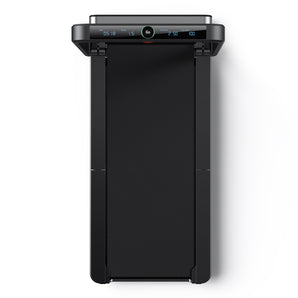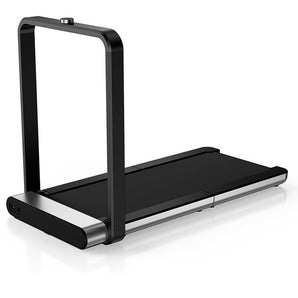

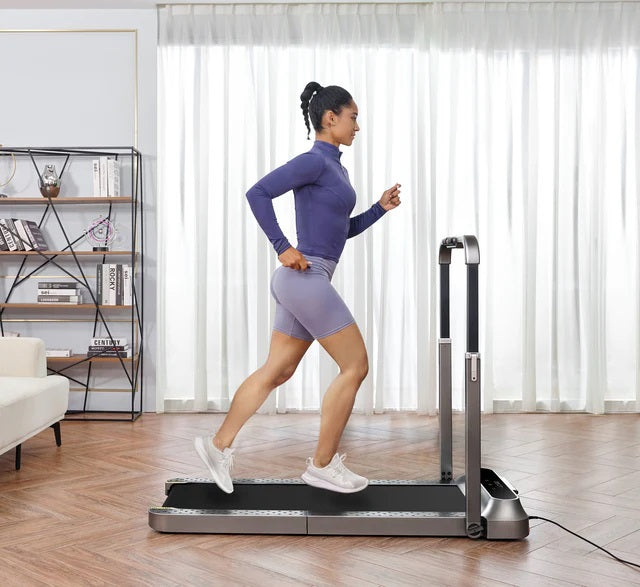
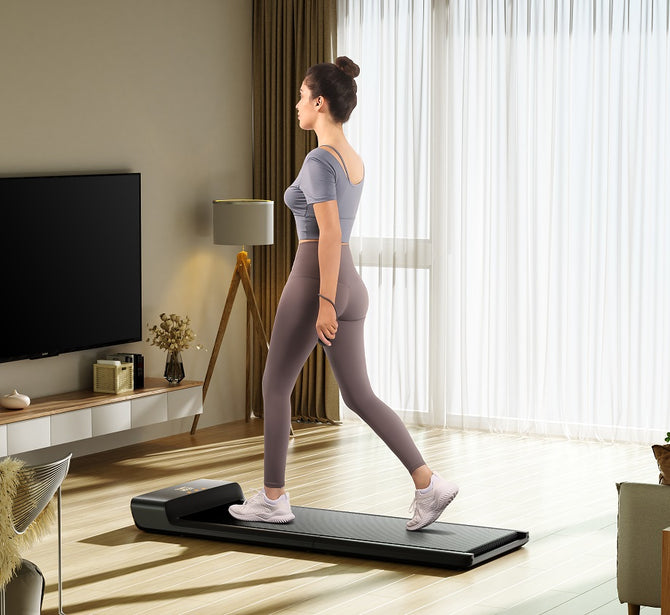




Your treadmill shows the speed in km/h, but your running schedule works with minutes per kilometer. And if you walk on a walking pad under your desk, you want to know what 4 km/h actually means for your step counter. Calculating treadmill speed is simpler than it sounds.
With three basic formulas you translate every setting on the display to a pace you can directly compare with your training schedule or daily step goal.
The difference between pace and speed on a treadmill
Speed and pace are often confused, but they express something different. Speed indicates how many kilometers you cover per hour and is displayed in km/h. Pace indicates how many minutes you take over one kilometer and is expressed in min/km. In English that's called pace.
On most treadmills you see speed in km/h on the display. Running schedules and race preparations almost always work with pace in min/km.
Why does that difference matter? Suppose: you run 9 km/h and think it's easy. But converted, that's a pace of 6:40 min/km. For most recreational runners that's already quite a challenging pace to maintain long.
The three formulas to calculate treadmill speed
To calculate the speed on your treadmill you only need three formulas, and they're all connected to each other.
Pace (min/km) = 60 ÷ speed (km/h)
Speed (km/h) = 60 ÷ pace (min/km)
Distance (km) = speed (km/h) × time (in hours)
An example: your treadmill is set to 8 km/h. Your pace is then 60 ÷ 8 = 7:30 min/km. The other way around: is there a tempo block of 5:00 min/km in your schedule? Then you set the treadmill to 60 ÷ 5 = 12 km/h. You don't need more than that in basics.
Calculating treadmill speed in practice
In practice you most often calculate the speed on your treadmill between km/h and min/km. On all treadmills in our range you see the speed in km/h on the display, while most running schedules work with min/km. Below are the two most common calculations.
Converting from km/h to min/km
You convert from km/h to min/km by dividing 60 by the speed. Suppose your treadmill is set to 9 km/h. Your pace is then 60 ÷ 9 = 6:40 min/km.
A few more examples: at 6 km/h your pace is 10:00 min/km (brisk walking), at 10 km/h exactly 6:00 min/km and at 14 km/h you run at a pace of 4:17 min/km. The latter is a race pace that many runners train for months to achieve.
Converting from min/km to km/h
Do you want to convert min/km to a treadmill speed in km/h? Suppose: your running schedule shows an endurance run at 6:30 min/km. Then the calculation is: 60 ÷ 6.5 = 9.2 km/h. Most treadmills work in steps of 0.1 or 0.5 km/h, so you round to 9.0 or 9.5 km/h.
At 6:00 min/km you set the treadmill to 10.0 km/h, at 5:00 min/km to 12.0 km/h and at 4:30 min/km to 13.3 km/h. The pattern is always the same: divide 60 by your pace and you have the right setting.
The incline of your treadmill affects how heavy a certain pace feels. At 0% incline, running on the treadmill feels slightly lighter than outside, because you have no headwind and the belt partly pulls through under you.
Converting most common speeds for the treadmill
With this conversion table you see at a glance which pace belongs to which speed setting on the treadmill. The 5 km and 10 km times give you a concrete idea of what each speed means in practice.
| Speed (km/h) | Pace (min/km) | Time over 5 km | Time over 10 km |
|---|---|---|---|
| 4 | 15:00 | 1:15:00 | 2:30:00 |
| 5 | 12:00 | 1:00:00 | 2:00:00 |
| 6 | 10:00 | 50:00 | 1:40:00 |
| 7 | 8:34 | 42:51 | 1:25:43 |
| 8 | 7:30 | 37:30 | 1:15:00 |
| 9 | 6:40 | 33:20 | 1:06:40 |
| 10 | 6:00 | 30:00 | 1:00:00 |
| 11 | 5:27 | 27:16 | 54:33 |
| 12 | 5:00 | 25:00 | 50:00 |
| 13 | 4:37 | 23:05 | 46:09 |
| 14 | 4:17 | 21:26 | 42:51 |
| 15 | 4:00 | 20:00 | 40:00 |
| 16 | 3:45 | 18:45 | 37:30 |
| 18 | 3:20 | 16:40 | 33:20 |
Do you prefer to walk at a calmer pace? Our walking pads reach speeds up to 6 km/h, which comes down to a pace of 10:00 min/km. For running training our treadmills offer speeds up to 18 km/h.
Common mistakes when calculating treadmill speed
When you calculate treadmill speed, the most common mistake is confusion between decimal point and colon in notation. 5.15 and 5:15 are not the same: 5.15 as decimal means 5 minutes and 9 seconds (0.15 × 60 = 9), while 5:15 is five minutes and fifteen seconds. Pay close attention to this when copying paces from a schedule.
Another pitfall for those who use apps like Strava: speed is sometimes displayed there in mph (miles per hour). Remember that 1 mile is 1.609 km. A pace of 8 mph is therefore not 8 km/h, but 12.9 km/h.
Finally, try not to train too precisely on numbers. Your treadmill makes speed very constant, but your body reacts differently than a machine. Check your breathing and heart rate in addition to the display.
Especially with interval training, feeling is sometimes a better gauge than the numbers on the screen. Do you want to know more about building up training? Then also read our article about weight loss with the treadmill.
Set up your treadmill properly
Now that you know how to calculate treadmill speed, you can set every training precisely. With the right speed and an incline of 1% you get more out of every session, at home or in the office.
Do you want to know which treadmill fits your training goal? View our complete range of treadmills and find the model that fits your pace. From walking pads for under your desk to running treadmills that can handle 18 km/h, and you try them free for 30 days.