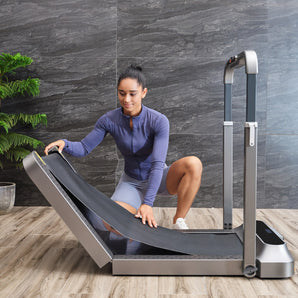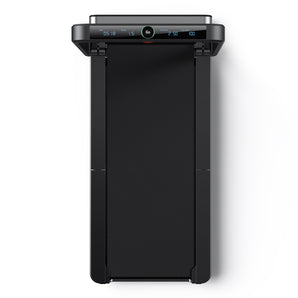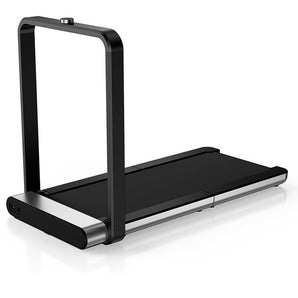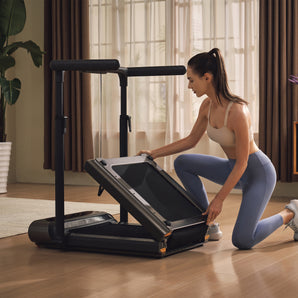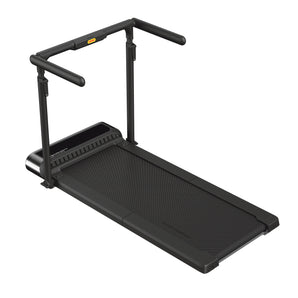





It can happen that your treadmill's belt shifts slightly to one side over time. This is a common and normal phenomenon and doesn't mean that something is immediately wrong with the treadmill. When the belt no longer runs neatly in the center, this can cause extra noise, friction or in some cases fraying on the side of the belt.
Fortunately, this problem is easy to solve yourself by adjusting the treadmill correctly. In this article we explain when you should adjust a treadmill, why the belt can shift and how you can do this safely and step by step.
Why does a treadmill belt shift?
It's completely normal for a treadmill to run slightly "off center" over time. During use, small forces continuously work on the belt and rollers, which can slowly change the adjustment. Fortunately, this usually doesn't mean something is broken, it's often simply a result of regular use.
These are the most common causes:
- Uneven load: you don't always walk perfectly straight or with exactly equal pressure left and right, which can cause the belt to gradually deviate.
- Floor not completely level: even a small tilt can cause the belt to pull to one side.
- Slight movement of the treadmill: minimal shifting during walking can affect the belt position.
- Stretching belt from use: over time the belt can stretch slightly, which can intensify misalignment.
These are normal processes that can occur with virtually all treadmills.
When should you adjust a treadmill?
A treadmill doesn't need to be adjusted often, but it's important to do this as soon as you notice that the belt is no longer running straight.
You usually recognize this by a belt that visibly shifts to the left or right, a scraping or ticking sound during use, or because the belt touches the side of the frame. Sometimes you also see that the edge of the belt starts to fray slightly.
When you notice one or more of these signals, it's wise to check the treadmill and adjust if necessary to prevent further wear.
How to adjust a treadmill
At the back or side of the treadmill there are adjustment points. These are small openings in which an Allen key fits. With these adjustment points you can make the belt run neatly in the center again.
Step 1: Check which way the belt shifts
Turn on the treadmill at a low speed and watch carefully whether the belt pulls to the left or right. This determines which adjustment point you should use.
Step 2: Use the correct adjustment point
If the belt shifts to the left, use the adjustment point on the left side. If the belt shifts to the right, adjust the right adjustment point. This way you correct the direction in which the belt runs.
Step 3: Adjust the belt in small steps
Turn the adjustment point clockwise and do this in small steps, for example about a third of a turn at a time. By making small adjustments, you prevent the belt from being corrected too far.
Step 4: Let the belt rotate again
After each adjustment, let the treadmill run for a few seconds and observe whether the belt moves more toward the center. Repeat this process until the belt stays neatly centered.
Step 5: Check the treadmill after adjustment
When you're finished adjusting, it's important to let the treadmill run for a while without walking on it. This way you can clearly see whether the belt stays running stably in the center.
If the belt still deviates slightly, you can make a small additional correction. Once the belt runs straight and no longer makes contact with the sides of the frame, the treadmill is ready for use again.
Tips to prevent belt misalignment
Misalignment isn't always completely preventable, but with a few simple habits you can significantly reduce the chance. By setting up your treadmill properly and checking it occasionally, the belt stays better centered and you need to adjust less often.
Useful tips:
- Place the treadmill on a stable, flat surface (preferably level)
- Walk as much as possible in the center of the belt and don't change your position too often
- Check the belt position regularly by visually looking to see if it still runs straight
- Follow the manufacturer's maintenance advice (such as lubricating and general inspection)
- Pay attention to unexpected vibrations or shifting and firmly reposition the treadmill if necessary
- By paying attention to this regularly, your treadmill will run more quietly and last longer.
Need help adjusting your treadmill?
Can't get the belt adjusted properly or are you unsure whether everything was done correctly? Don't worry: in most cases it's a matter of small, targeted adjustments and testing in between. Always adjust in small steps and let the treadmill run briefly to check whether the belt runs nicely in the center again.
More friction can affect the belt. Regular maintenance, such as lubricating the treadmill, helps limit this. With the right maintenance and a small adjustment when needed, you can continue to enjoy a smoothly and stably running treadmill.